
Let Them Eat Cake
Your hurt is the last of our concerns right now

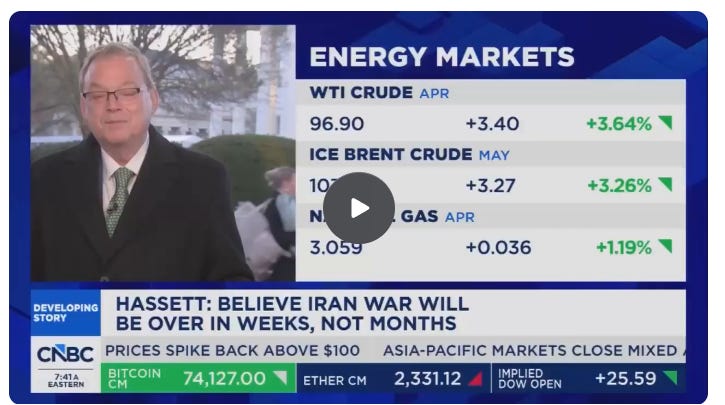
White House National Economic Council Director Kevin Hassett said on CNBC that “If the war were to be extended, it wouldn’t really disrupt the US economy very much at all. It would hurt consumers, and we’d have to think about what we’d have to do about that, but that’s really the last of our concerns right now.”
US spending on first week of Iran war raises stark questions about priorities
$11.3bn more than enough to fund EPA or National Cancer Institute, where administration sought to slash budgets https://www.theguardian.com/us-news/2026/mar/18/us-spending-iran-war-priorities
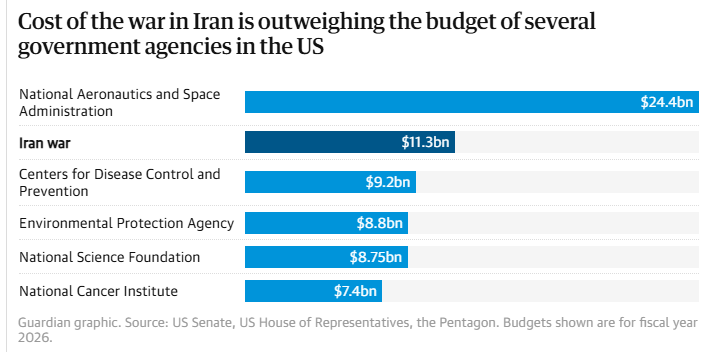
The US spent $11.3bn on just the first week of its military assault on Iran. This huge expenditure dwarves the annual budgets of many of the public health and scientific agencies the Trump administration has sought to cut, raising stark questions about the country’s priorities.
In the six days that followed the US and Israel’s joint attack on Iran on 28 February, $11.3bn was spent on American taxpayer-funded bombs that hit the country and caused hundreds of deaths, the Pentagon has told lawmakers. This figure does not capture the full cost of the conflict, such as deployment of forces, and will now be far higher given the ongoing nature of the war.
But even the limited snapshot of the financial cost of the war has underscored the enormous disparity between the amount spent by the US on its military compared with the budgets of agencies tasked to keep Americans’ air clean, help find new cures for cancer and devise new scientific innovations.
The cost of the first week of the Iran war would be more than enough to fully fund the Environmental Protection Agency this year (at $8.8bn), the Centers for Disease Control and Prevention ($9.2bn) or the National Cancer Institute ($7.4bn). The $11.3bn is also more than the total amount allocated this year for federal scientific research funding, via the National Science Foundation.
“This just shows a disturbing prioritization of militarism over the health and welfare of the American public,” said Adam Gaffney, a professor at Harvard Medical School who has studied the health impacts of the administration’s policies.
“With that money, we could be doubling public health expenditures or doubling environmental protections ensuring that Americans have clean air and water. We could bring healthcare to millions of Americans. Instead, we are putting that money into a war of choice.”
We could also have given away 198,915 electric vehicles at $55,300 each. Or we could have purchased and installed anywhere from approximately 70,000 to over 300,000 electric vehicle charging ports, depending on the mix of slow and fast chargers. Or we could have insulated 1.5 million to 3.6 million uninsulated or under-insulated homes. With $11 billion, we could install approximately 3.5 gigawatts (GW) of wind power, enough to power around 3 million homes, as shown by the SunZia project in New Mexico. This major infrastructure project includes over 900 turbines and 550 miles of transmission lines to deliver clean energy.
Until we can get rid of administrations whose policy philosophers include people like Kevin Hassett, we are committed to relegating ourselves to peons in a petroligarchy.
Across the Pacific Ocean, for irony, a large nation that was never the land of the free or a Democracy, a nation with one of the worst human rights records on planet, has passed a major new environmental protection lawn dubbed “Blue Skies, Green Mountains.
China’s legislators approved a sweeping new environmental law that’s seen as supporting President Xi Jinping’s ambition to strengthen ecological and climate protections while also ensuring economic growth.
The Ecological and Environmental Code endorsed Thursday at the closing session of the once-a-year National People’s Congress consolidates a raft of previous legislation, including on air quality, low-carbon development and penalties for corporate polluters.
Xi, a proponent of environmental protection for more than two decades, famously declared “lucid waters and lush mountains are invaluable assets,” in a 2005 speech, and is continuing to demand improvements under China’s latest Five-Year Plan through 2030.
The new law “demonstrates a kind of special attention and priority given to ecological and environmental protection,” said Ma Jun, founder of the Institute of Public and Environmental Affairs, a Beijing-based nonprofit. “That’s probably the most prominent point of it — to demonstrate that strong support and political will.”
Meanwhile, Iran’s ability to delay or prevent the movement of oil through the Strait of Hormuz means that the costs of fertilizer and many pharmaceuticals are likely to rise.
India is the third-largest pharmaceutical producer by volume and the largest provider of generic drugs in the world. Known as the “pharmacy of the world,” India accounts for 20% of global generic exports, 60% of worldwide vaccine demand, and 40% of generic demand in the U.S., per Wikipedia.
It is the largest manufacturer of generic medicine in the world, supplying over 50% of global vaccine demand. It exports to over 200 countries, with the US being the largest market (34% of exports).
It has the highest number of US FDA-approved plants outside the United States.
The difficulty is that crude oil is a foundational feedstock for India’s pharmaceutical industry. Crude oil is the source of the raw materials for petrochemicals used in manufacturing active pharmaceutical ingredients (APIs), solvents, and drug packaging. About 90-99% of pharmaceutical feedstock is linked to petrochemicals derived from oil and gas, making India’s pharmaceutical supply chain dependent on crude oil supply and price. While India has bought about 60% of its API’s from China, and Iran has as recently as March 16 that the Strait is open to all traffic except that of its enemies, there are dicey moments between Iran and India.
“The Strait of Hormuz is open, it is only closed to the tankers and ships belonging to our enemies, to those who are attacking us and their allies. Others are free to pass,” Iranian Foreign Minister Abbas Araghchi said on the weekend.
India freed three Iranian oil tankers that had been seized last month to secure Iran’s permission for two Indian vessels to pass through the Strait of Hormuz, according to the Iranian newspaper Sharq, which also reported negotiations to resolve “issues related to maritime security and oil trade between the two countries.”
India, the world’s fastest-growing major economy, imports about 85% of its liquefied petroleum gas from the Middle East, much of it used in cooking food for its 1.4 billion people.
With supplies impacted by the US-Israel war with Iran, the Indian government has begun diverting the fuel away from hotels and restaurants, to keep fuel available for household stoves.
At this juncture, with fertilizer, pharmaceuticals, and cooking fuel at risk, a cynical capitalist might invest in those commodities. It appears that prices will rise, and there is no certainty about how long the effects of this war will last.
Very well-written! Thank you.
Shameful