
Losing and Winning
We have some wins this week to counter the trend

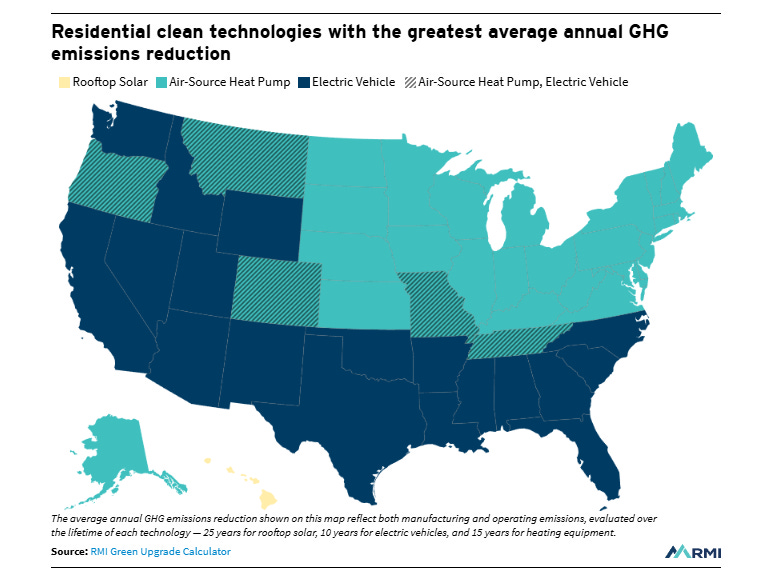
Roll On, EVs - Electric Vehicles Cutting GHG Emissions
In terms of emissions, EVs deliver the largest average annual GHG emissions reduction in the majority of states compared to the other residential clean technologies, reducing residential transportation emissions by an average of 51% compared with a gasoline car. ASHPs lead in the Northeast and Midwest, where they lower average annual GHG emissions by 40% when displacing high-emissions fossil fuels such as fuel oil and propane. Several states, including Colorado, Missouri, Montana, Oregon, and Tennessee, show comparable emissions reduction potential between ASHPs and EVs. Hawaii stands apart: rooftop solar delivers the greatest emissions impact there, given the state’s exceptionally carbon-intensive grid.
EVs deliver strong emissions reductions primarily because they avoid the high carbon intensity of gasoline and are far more efficient than gasoline vehicles. For example, light-duty EVs can achieve 130 miles per gallon of gasoline equivalent, compared to about 25 miles per gallon on average across all light-duty models. As grids continue to decarbonize, these emissions reduction impacts are expected to increase over time.
The lifetime economics of EVs are shaped by two factors above all else: the local spread between electricity and gasoline prices and the average annual mileage per state. EVs have a lower total cost of ownership (including up-front and operating costs over time) where gasoline prices are high relative to electricity, although the economics remain cost-competitive across a wide geography. Lower maintenance costs add to the advantage: no oil changes, fewer moving parts, and reduced brake wear. In 18 states, EV drivers can reduce their total costs of ownership by more than $5,000 over 10 years compared with gasoline vehicle drivers. Those savings compound with greater vehicle use, making EVs particularly attractive for high-mileage households.
Greenhouse Gas Reduction Fund Might Live Again
Earlier this week, the D.C. Circuit Court of Appeals ruled that the Trump administration could not end the $20 billion Greenhouse Gas Reduction Fund program, which would have capitalized several national green banks. The court also ruled that the Environmental Protection Agency needed to give the nonprofits access to the funds while the case proceeded.
That would amount to a victory — if it holds.
But the ball is now in the EPA’s court. If the agency appeals the ruling in the next week, then the case will go to the Supreme Court, setting up what could be a major battle over the program, according to The New York Times
Congress created the grants, known as the Greenhouse Gas Reduction Fund, as part of the Inflation Reduction Act in 2022. It authorized Biden’s EPA to award $20 billion to a handful of nonprofits that would then offer financing to individuals and organizations for emission-reduction projects, mostly geared toward low-income or otherwise disadvantaged communities. The agency fully obligated the funds last August to eight nonprofits that would “create a national financing network for clean energy and climate solutions across the country.
Then Trump took office and ordered his agency heads to pause and review all funding for Inflation Reduction Act programs. EPA Secretary Lee Zeldin targeted the Greenhouse Gas Reduction Program for termination, making a big show of a covert recording of a former agency employee comparing Biden’s efforts to get climate money out the door after the election to “throwing gold bars off the edge” of the Titanic. Never mind that this particular program had been fully obligated prior to the election, and recipients had already started to announce investments as early as October.
The EPA may take the matter up to the Supreme Court, in which case, we will see whether the Court can find a way to overrule the D.C. Circuit Court of Appeals.
Trump administration may be forced to start reviewing wind projects again
The Department of Defense halted reviews of onshore wind projects in May on national security grounds, a move that Jael Holzman described at the time as “extrajudicial” and that would ultimately “murder an American industry.”
Now the judiciary is getting involved. On Tuesday, U.S. District Judge Karin Immergut, a Trump appointee, indicated that she would likely find in favor of a coalition of renewable energy groups that sued the Trump administration to restart reviews. At the start of a two-hour hearing, Courthouse News Service reported from the federal courthouse in Portland, Oregon, Immergut said there was “strong evidence the government had violated statutory and regulatory deadlines” when the Pentagon stopped carrying out routine reviews needed to progress federal permits for wind turbines to the Federal Aviation Administration.
Hell Has Frozen Over. Texas Regulates Data Centers.
The country’s fastest-growing market for data centers is, for now, frozen. Governor Greg Abbott of Texas announced on Monday that the state’s grid authority should not allow any more data centers to hook up until state regulatory agencies complete an audit of existing projects.
As part of this audit, data center developers will have to disclose the following, according to the governor:
any tax incentives they benefit from,
their water and energy use,
their physical footprint on the land,
their plans for future energy use, and
their owners.
“Any data center project that fails to comply … must be denied” a grid connection, Abbott wrote in a letter to the agencies.
Bezos Earth Fund to Donate $200 Million to Save 100 Critically Endangered Species.
The Bezos Earth Fund and conservation organization Re:wild — respectively set up by Amazon founder Jeff Bezos and actor Leonardo DiCaprio — have announced the Phoenix Species Project, a US$200-million project that aims to save 100 critically endangered species worldwide. “More than 100 local and international partners around the world — including Indigenous Peoples, local communities, conservationists, and governments — will lead the work, tailoring recovery efforts to each species and place,” states the press release. The International Union for the Conservation of Nature’s (IUCN) Species Survival Commission is collaborating with the project. For perspective, IUCN’s Red List includes 10,947 species in the ‘critically endangered’ category. Scaling up the Phoenix Species Project’s average investment per species to cover all of them would cost an additional US$21.7 billion — less than ten percent of Jeff Bezos’s net worth of US$279 billion, according to Forbes’s real-time billionaire tracker.
For comparison, the California Department of Fish and Wildlife routinely awards tens of millions through its Fisheries Restoration Grant Program, including targeted multi-million dollar infusions from cannabis tax restoration grants and specific North Coast coho project augmentations to restore the endangered coho salmon.
The Faint Glow of Life
All living cells emit a faint glow, thanks to ‘biophotons’ produced by their metabolic activity. In the past, researchers have theorized that cells might use this glow as a way of communicating with one another, but the idea was dismissed as pseudoscience. Now, the study of biophotons is making a comeback, with some researchers hopeful that a cell’s glow could be a subtle marker of health, or a way of sending signals to its neighbors. “It’s one of those fields that feels like it is on the edge of respectability,” says biochemist Nick Lane.
And A Loss, With A Promise of Accountability
“Trump just paid RWE over $1 billion in taxpayer money to walk away from offshore wind projects – including a project off Humboldt in my district – and invest in fossil fuels instead.
“This fake, illegal settlement kills good-paying jobs, raises electricity costs, and rewards Big Oil with taxpayer dollars.
“When the accountability comes, and I promise you it’s coming, everyone involved in these deals will answer for it.” -- California Congressman Jared Huffman
The New York Times reports it thusly:
On Thursday, renewable energy company RWE announced that it entered into a $1.22 billion agreement with the Trump administration to relinquish its offshore wind leases. RWE is one of two companies, alongside Vineyard Offshore, that hold wind leases off California’s North Coast through its RWE U.S. Offshore subsidiary.
According to a press release published by RWE Thursday morning, the company’s settlement with the U.S. Department of Interior will “resolve claims against the U.S. government and relinquish its offshore wind leases off the coasts of New York, California and Louisiana.”
“RWE U.S. Offshore secured these leases from the U.S. government with a long-term commitment to develop offshore wind capacity in American waters and invested more than $1 billion toward the leases and the development of these projects,” RWE’s release reads. “These leases provided legal rights to develop offshore projects and represented years of planning, investment, and partnership with federal agencies.
“After careful consideration, it was determined there is no path forward to permit these projects in the U.S. for the foreseeable future. The settlement resolves RWE U.S. Offshore’s legal claims and provides $1.22 billion in settlement funds. The company determined that this resolution best serves the interests of its stakeholders and allows it to direct resources toward energy projects that can be advanced with certainty.”
That’s an interesting conclusion, but a rational mind would ask on what basis that determination was made. I’m too bored with pernicious corruption to break it down; I can’t make it humorous or entertaining or engaging.
It’s the weekend, Please take care of your health and wellbeing.