
Some Things We Should Know About Oil and This Summer
Come June, Things Will Be Much More Expensive. Come September, They Won't Be Available.

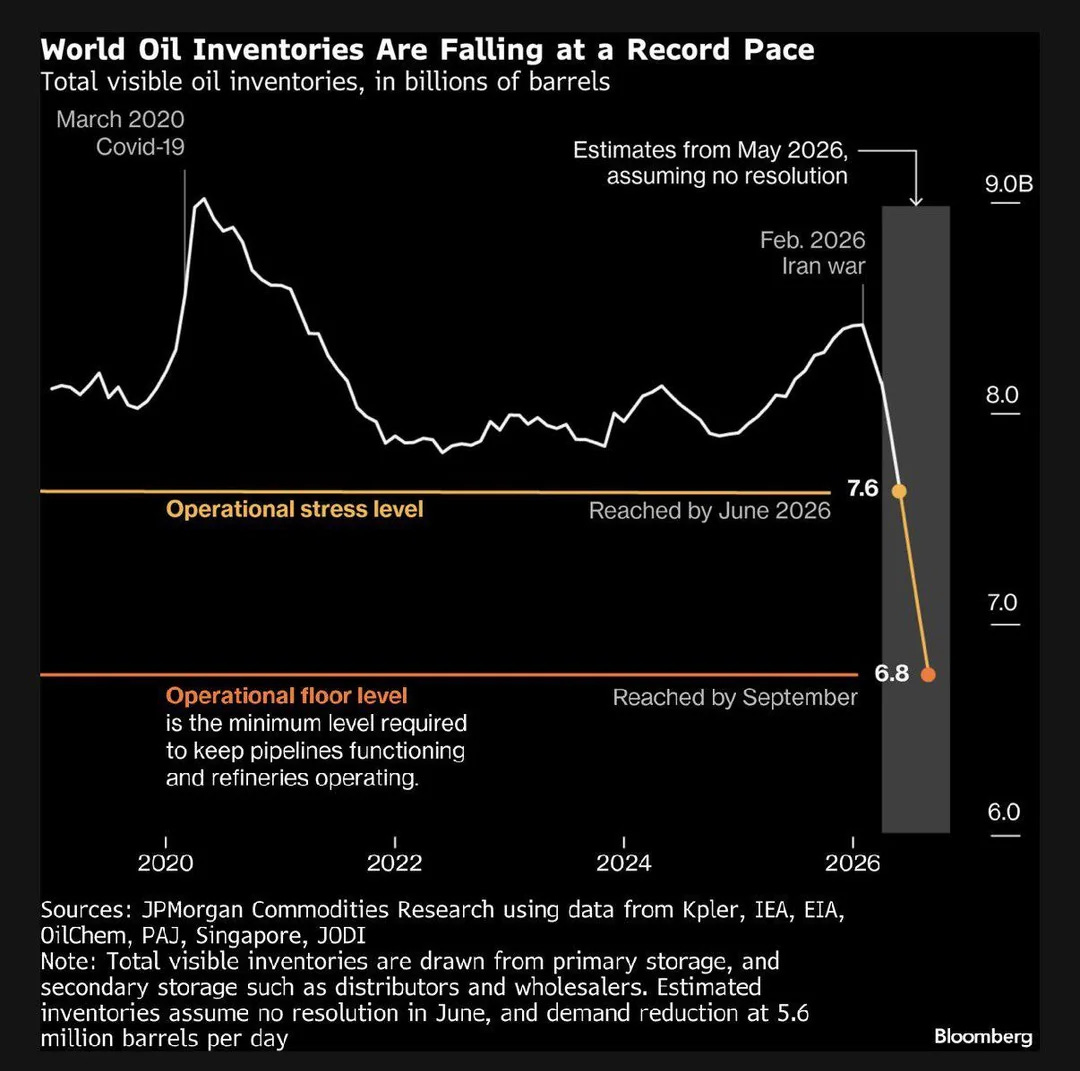
Please read the description in the above chart “Operational Stress Level” in June. This means that if the war in Iran and the closure of the Strait of Hormuz is not over by first week of June, we will be being asked to turn off our air conditioners, to turn off our computers when not in use, to limit our time outside, to take public transit instead of driving. It means that in addition to the price of gasoline, the prices of things like ink and paper for your printer, fruits and vegetables, tylenol and advil, will rise. And it means that orders for many kinds of Christmas goods, usually ordered in June, will not be fulfillable. And some airlines are already suspending some flights. Here is a list. (Subject to change, of course.)
Also, a refinery exploded in the past week, in Chalmette, Louisiana. It made aviation fuel.
Please read the description in the above chart “Operational floor level is the minimum level required to keep pipelines functioning and refineries operating” in September 2026.
This means that if the war in Iran and the closure of the Strait of Hormuz is not over by September or earlier, countries will be unable to feed people; it means starvation. It means rationing water and electricity.
In the United States, which is a consumer and service economy, and no longer a production economy, most of our products are imported from China, Europe, India, Latin America. We are dependent on the world economy. We are not independent of Europe, for example. If European nations are struggling and can not meet their people’s needs, then they will not be exporting their food, pharmaceuticals, fertilizers, finished products, to us.
Writing in Oilprice.com, Irina Slav reports “Even if the conflict, and I hope so, will end in the month of May, we would exit the conflict with clearly some very low inventories,” TotalEnergies’ chief executive Patrick Pouyanne said most recently, noting that per the company’s estimates, the world has been drawing oil from stockpiles at a rate of between 10 and 13 million barrels daily. This comes in at a total of 500 million barrels already drawn from global inventories since the start of the war, Reuters reported, citing the executive.”
So why would the United States Trump not want to end the war as soon as possible?
Not only because he wants to “win,” as he has stated. But also because Someone is profiting Bigly from manipulating oil prices.
Paul Krugman has written about this crime against humanity and the earth market manipulation.
Insider trading. Oil futures. The War in Iran. Why it will keep going on.
The narrow answer involves economic efficiency. How is the functioning of the economy affected by the realization that somebody — it’s not hard to make guesses, but we don’t know for sure — is trading oil futures based on advance knowledge about what will soon appear on Truth Social or Fox News?
It took me a while to figure this out. But I think I have an answer.
First, ask yourself what purpose is served by the oil futures market. Unlike the prediction markets Polymarket and Kalshi, the oil futures market is not intended to be mainly a vehicle for gambling. Instead, it is a market that serves to reduce risk through hedging.
Here’s how it works. There are people and institutions, such as oil producers, who will need to sell oil at a future date. They want to lock in the price today on those future sales. There are also people and institutions, such as airlines, who have a future need for oil and would like to lock in the price today. Thus the futures market lets both sellers and buyers of oil eliminate a major source of risk – fluctuations in the price of oil. This reduces uncertainty in the economy as a whole.
But what if there are substantial players in the futures market with inside information? Then if you are, say, a corporation trying to lock in the price of oil you plan to buy next month, you may not be making a mutually beneficial deal with future sellers. You may, instead, be being played for a sucker — paying what in retrospect will have been an excessive price — by people who know what’s about to appear in the president’s social media feed.
The same could apply to sellers of oil futures, although the examples of insider trading we know about involved Trump insiders getting ahead of falling, not rising, prices.
Either way, the effect of traders’ suspicion that they may be losers in a rigged game will be to make them reluctant to play at all — reluctant either to buy or to sell oil futures. And this will mean losing the risk-reducing benefits of a properly functioning futures market.
Now, insider trading of oil futures probably isn’t big enough to do critical damage to those markets. But it does do damage, which hurts all of us, not just the buyers who got stuck with the immediate losses.
And beyond the narrow economic losses, insider trading on oil is part of the broader rise of what we can call the predation economy.
Under Trump II, corruption runs rampant. Success in business depends not on what you know but on who you know, and there are no rules beyond having — and, obviously, buying — the right connections.
This is bad for everyone who doesn’t have those connections. It’s bad for economic growth. And it undermines the moral basis of the economy and society as a whole. It’s the path of how a country slides into third-world status.
Well, are we stuck with the Iranian hold on oil through the Strait of Hormuz? For how long?
We read in our World History that Prince Henry the Navigator sailed around the Cape of Good Hope seeking a route to Asia that would "turn the Muslim flank," bypassing the Mediterranean and overland silk trade controlled by Islamic states.
Harmoniously, Saudi Arabia has an East-West oil pipeline, twin pipes and a series of pumping stations that carry oil more than 745 miles connecting the Abqaiq oil field in the Eastern Province to the port of Yanbu on the Red Sea. The 40-year-old Petroline is reported to be operating at full capacity.
According to reports by Bloomberg, Saudi national oil company Aramco initiated plans to ramp up Petroline operations when the US-Israeli war with Iran began on Feb. 28. By March 4, it was already operating at close to full capacity, and tankers that would normally be heading to terminals in the Arabian Gulf were instead heading to the Red Sea.
How much oil? That’s 7 million barrels a day through the Petroline, as against the loss of the 15 million barrels that normally pass through the Strait of Hormuz. So about half or less of the Iranian strangleheld oil. And then there are the Houthis. As of Saturday, the Houthis have said they’re entering the war. Bloomberg reported on Saturday, “flotillas of tankers have been redirected to the Red Sea port of Yanbu to collect the oil, providing an important lifeline for global supply.”
But, “with the Houthis now saying they are entering the war, the concern for the oil market will be that the Red Sea becomes a new front in the conflict.”
The Houthis had kept out of the war until Saturday, when they fired missiles at “sensitive military sites” in Israel, in an echo of the multiple attacks they launched against the country in support of Hamas following the Oct. 7, 2023, attack.
There’s more, but enough with the Middle East rabbit holes for now. The point is that Somebody is profiting from the war, the planet and the rest of the people of earth are suffering, the only imaginable end in sight has some severe costs.
There will come a point when oil companies can no longer profit from this war. At that point, they may withdraw their support for this administration. It may not make any difference. I simply can not read the situation.
Can you?
With the profits the oil corps is making now, it can afford to coast for a while if it puts pressure on Iran to trade in the petro-dollar.