
What Is Love?
Immigrant Safety, Doctors, Roads, and Clean Energy

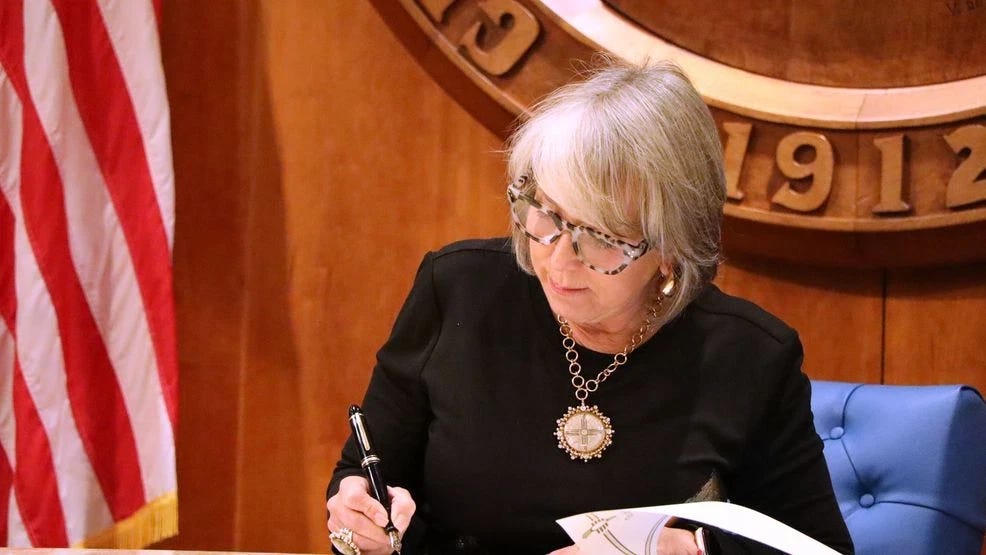
New Mexico Governor Michelle Lujan Grisham signs bills
New Mexico governor signs Immigrant Safety Act into law
SANTA FE, NEW MEXICO (KFOX14/CBS4) — New Mexico Gov. Michelle Lujan Grisham has signed four bipartisan bills into law, focusing on improving health care access, investing in statewide infrastructure, and addressing immigration detention facilities.
Among the new laws is House Bill 9, known as the “Immigrant Safety Act”, which would not directly close down immigrant detention centers, but would forbid counties and local law enforcement from contracting with U.S. Immigration and Customs Enforcement (ICE).
The legislation mandates that public bodies terminate any existing immigration detention agreements as soon as possible and prohibit the use of public property for federal civil immigration detention.
In New Mexico, there are three immigrant detention facilities, Torrance County Detention facility, the Otero County Processing Center, and the Cibola County Detention Center.
New Mexico joins other states that have also introduced or passed similar legislation, including California, Illinois, Maryland, New Jersey, New York, Oregon, and Washington.
The other signed bills include Senate Bill 1, which allows physicians licensed in other compact states to practice in New Mexico, addressing the state’s health care workforce shortage.
House Bill 50 streamlines the licensure process for social workers, expanding support for children, families, and vulnerable populations.
Senate Bill 2 provides funding for infrastructure projects, supporting road improvements and transportation systems.
Both a clean energy vehicle and a home heating provider
As ice, snow and bitter cold stresses America’s power infrastructure, electric vehicles have filled in as emergency power sources, shifting from transportation to home backup batteries.
US drivers have now bought about 630,000 electric cars and trucks capable of discharging electricity at levels strong enough to power a home or apartment, according to Cox Automotive and company sales reports. That figure is rising quickly, too. One in five EVs purchased in the past quarter had so-called V2H — or vehicle-to-home capabilities — and analysts say the feature will soon be table stakes for those hoping to sell an electric car.
At the moment, 14 of the 70 or so EV models available in the US offer bidirectional charging. Every auto in the General Motors Co. product line can now power a home in a pinch, as will high-end models from Hyundai Motor Co., Kia Corp. and Volvo Car AB.
That share is likely to climb in coming months. BMW Group has promised bidirectional charging in its new iX3, a pledge echoed by Tesla Inc. for its next Model Y and Rivian Automotive Inc. regarding its R2 SUV expected to hit the market in the next few months.
That’s the way the docs are in Texas: Many contemporary EVs have vehicle-to-load capabilities, which essentially turn the vehicle’s charging port into an electrical outlet. A few years ago, a doctor in Texas famously used his Rivian to power surgical tools for a vasectomy.
Solar and wind energy use is surging, even in the United States
Solar and wind electricity generation grew 109% worldwide last year, pushing these renewable sources past coal for the first time as a global energy supplier, according to an analysis by Ember Energy Research. More than 600 gigawatts of solar electricity were added last year, led by China and also including India, Brazil, Vietnam, the European Union, Kenya, and Mozambique. African experts say much of the continent is leaning heavily into solar and wind as it electrifies new regions and industries, bypassing fossil fuels.
Even in the U.S., renewable generation grew substantially, with solar generation up 37% last year and wind up 12%. The Energy Information Administration says renewables provided 24% of U.S. electricity generation last year. For at least one month, March 2025, renewables supplied more than half the electricity generated nationwide. That was the first time ever that fossil fuels supplied less than half of total U.S. electricity generation. Solar alone provided about 85% of all new electricity added to the U.S. grid last year, according to the Solar Energy Industry Association.
The cost of solar and wind generation plummeted in the past 15 years. Utility-scale solar generation, meaning the cost to an electric utility to generate electricity from solar, fell 85% in the decade between 2010 and 2020.
Solar and wind are less expensive for generating electricity than natural gas or coal, according to PV Magazine’s report on Lazard’s Levelized Cost of Energy for 2025. Utility-scale solar costs between four and eight cents per kilowatt-hour, even without the subsidies that Republicans killed with the reversal of the Inflation Reduction Act. With battery storage added, solar generation costs five cents to 13 cents. By comparison, generating electricity from natural gas costs 13.8 to 26 cents per kilowatt-hour, according to PV magazine and Lazard. Coal is even more expensive.
“The big thing that is happening is the very rapid rise of clean energy around the world, happening over the last six months,” said climate author and activist Bill McKibben, speaking to journalists in January, citing this as one of the major developments in climate right now.
The cause is “the dramatic reduction in the price of clean energy, which is shaking up all of our assumptions,” he added. For a long time, solar and wind were called “alternative energy,” but now they are the dominant source of new energy across the globe, “so there’s nothing alternative about them,” he added.
Cherry on Top: The Trump administration is now 0-5 in its effort to stop wind farms under construction along the East Coast, Maxine Joselow reports. Judge Royce Lamberth of the U.S. District Court for the District of Columbia issued a preliminary injunction that would allow the developer of the multibillion dollar wind farm known as Sunrise Wind, off the coast of New York, to restart construction while the broader legal battle unfolds, protecting billions in investment and paving the way for enough clean, cost-stable electricity to power about 2.5 million East Coast homes and businesses.
In December, the Interior Department ordered all work to halt on Sunrise Wind and four other wind farms off the East Coast. To justify the sweeping move, officials cited a classified report by the Defense Department that they said found the projects to be a national security threat.
Judge Lamberth issued a preliminary injunction that would allow the project’s developer to restart construction while the broader legal battle unfolds. “Purportedly new classified information does not constitute a sufficient explanation for the bureau’s decision to entirely stop work on the Sunrise Wind project,” the judge said.
By the way, if you don’t know about Judge Royce Lamberth, check him out.
And another cherry on top: Katie Miller, the right-wing influencer and wife of Trump adviser Stephen Miller, has been promoting the value of solar and batteries in posts on X.
Federal judge rules Texas law penalizing fossil fuel critics unconstitutional
A federal judge in Texas struck down a 2021 law barring state agencies from investing in firms accused of boycotting fossil fuel companies, ruling that the statute was unconstitutional. In his decision, Judge Alan D. Albright of the U.S. District Court in Austin blocked the state from enforcing the law, known as SB 13, which he ruled was targeting activities protected by free speech rights.
And that’s Love Today.